About this chapel and its furnishings
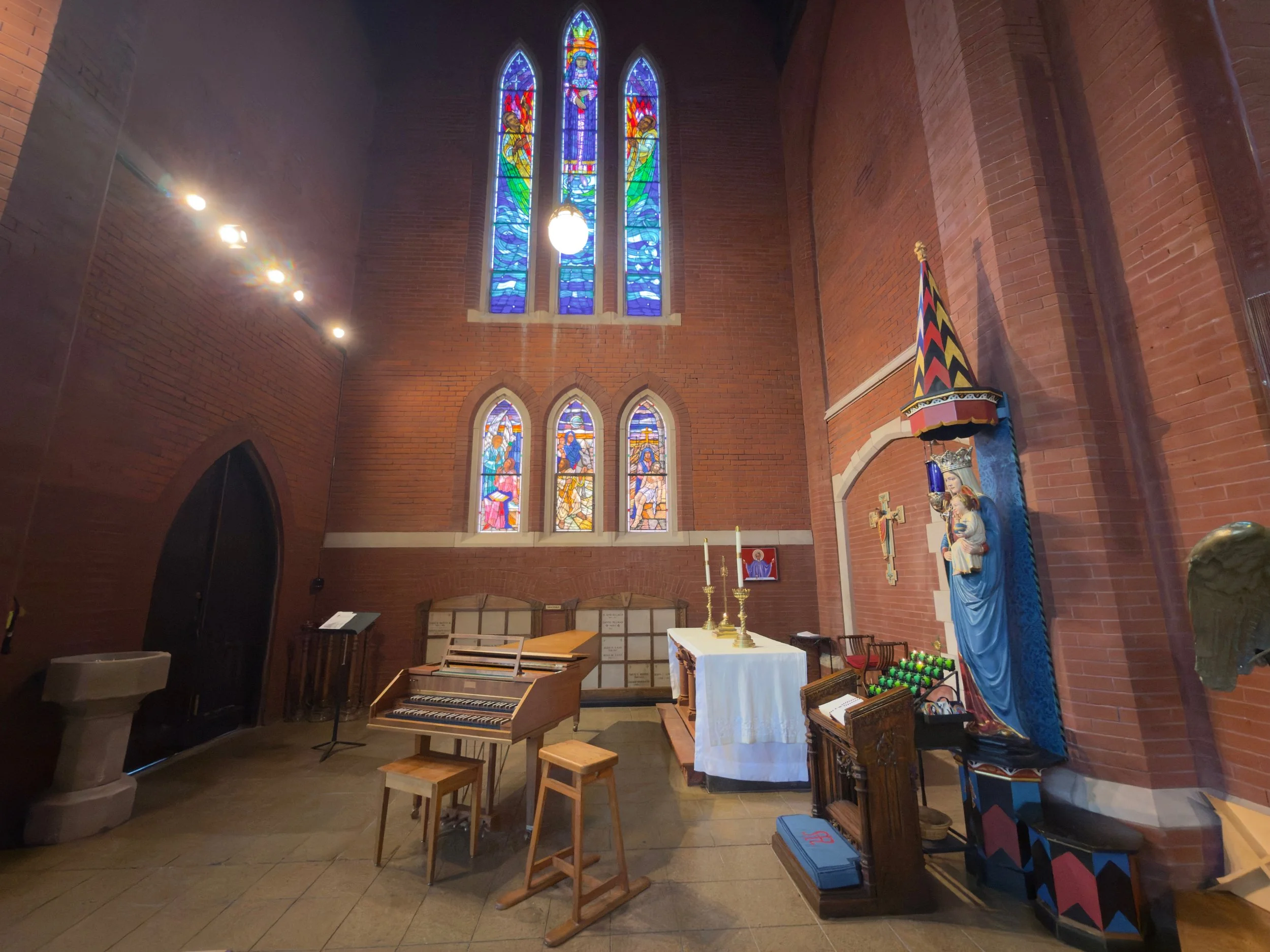
Welcome to this Chapel dedicated to the Blessed Virgin Mary, known to All Saints’ parishioners as The Mary Chapel. The Mary Chapel has been a source of restoration and solace for generations. People have offered countless prayers here before the statue of Our Lady Queen of Saints which was given in memory of the Reverend Father Felix Cirlot by Jean and Phil Smith. The statue, dedicated on September 29, 1957, is the work of Robert Robbins, a distinguished New York sculptor. Like many representations of the Blessed Virgin Mary and Jesus from the 1950s, the statue shows a blond, blue-eyed Jesus in the arms of his northern European mother.
During the height of the AIDS epidemic, when many churches would not hold services for those who had died of HIV/AIDS, All Saints held funeral masses as frequently as once a week. Those who were afflicted by AIDS and those who grieved the loss of loved ones knelt in prayer and lit candles before our Mary statue. Now, Sunday after Sunday, parishioners young and old, straight and gay, Black, Brown and White, stop to kneel in prayer after receiving Holy Communion.
Located above and to your left are stained glass windows depicting the life of Our Lady. They were designed and installed beginning in 2019 by Brook Camden, a local stained glass artist. After many parishioner conversations and the committee’s deep reflection, it was decided that the windows should reflect people from Jesus’ time. Scenes were chosen with particular care. They remind us that we turn to Mary when we are refugees from an antagonistic world, when we are silent witnesses to injustice, and when we fail to answer God’s call to “strive for justice and peace among all people, and respect the dignity of every human being.”
The focal point of the Mary Chapel is the large terra cotta altar – an altar with a complicated and troubling history. Its history had faded from corporate memory until 2020, when the Union of Black Episcopalians (UBE) sponsored a resolution at the diocesan convention asking all parishes to study their history to understand better and to redress the effects of racism and white privilege.
In response to the resolution, the Anti-Racism Committee of All Saints was formed. One of its first actions was to examine the parish’s church architecture and icons through a racial lens. The committee began a review of the ways white privilege had limited the parish’s vision for art and architecture. Did these expressions extend to everyone the welcome All Saints intended?
The dominance of white icons was an immediate concern, but the Mary Chapel’s altar was what riveted the committee’s attention when its connection with the Confederacy was uncovered. The Episcopal Diocese of Indianapolis’ historian, Lee Little, referred to the Mary altar as “the Stringfellow altar.” Who was this person after whom the altar was named?
The Reverend Horace Stringfellow served Christ Church (now Christ Church Cathedral) during the Civil War. As part of his parish work, Stringfellow provided pastoral care to Confederate soldiers interned in Indianapolis and was suspected of aiding and abetting the enemy. Horace Stringfellow resigned his position at Christ Church and returned to Virginia where he served as a chaplain in the Confederate Army for the rest of the war. Following the surrender of the Army of Northern Virginia to Union commander Ulysses S. Grant on April 9, 1865, at the Appomattox Court House, Stringfellow returned to Indianapolis where St. Paul’s Episcopal Church called him as their first rector. Stringfellow served St. Paul’s as rector until 1869 when St. John’s, Montgomery, Alabama, the home parish of the president of the Confederate States, Jefferson Davis, called him to be their rector. Horace Stringfellow was rector of St. John’s until his death in 1893.
The Indianapolis Journal published an article entitled, “The Growth of St. Paul’s,” on July 8, 1901. The article quotes the then rector of St. Paul’s, the Reverend Lewis Brown, referring to Horace Stringfellow as St. Paul’s sainted founder. The same article describes the church’s new chapel which was established as a memorial to Stringfellow and other early leaders.
The diocesan historian, Lee Little, attested to the chapel’s name: The Stringfellow Memorial Chapel, In the chapel, a newly-dedicated terra cotta altar memorialized Sally Holliday. It appears the name Stringfellow became associated with the altar because he was so revered by the parish.
When St. Paul’s was renovated in the early 2000’s, the chapel’s design could no longer accommodate the altar. All Saints’ book of memorials says the parish accepted the altar in 2010 as a gift from St. Paul’s in memory of the Right Reverend David B. Knickerbocker, Bishop of Indiana from 1883-1894.
By the time All Saints accepted the gift, the many associations between the terra cotta altar and the Reverend Horace Stringfellow seem to have evaporated. All Saints’ Rector Emeritus, the Reverend Gordon Chastain, who also had served St. Paul’s during his ministry, reports no knowledge of the altar’s Confederate connections during his tenure there.
In excavating and then remembering this history, All Saints recognizes the Episcopal Church’s complicity with slavery and our collective part in perpetuating the injustices caused by what Frederick Douglass called “the great sin and shame of America.”
The history you are now reading serves as All Saints’ explicit commitment not to forget our corporate history and our effort to renew this parish’s dedication to justice.
Although the altar is a large and visible reminder of our complicity with racism, it is worth remembering that the altar is consecrated to the God who redeems us so we can be freed from the bondage of sin, ready and willing to serve God and our neighbors. You are invited to offer the following prayer:
Mary, Mother of God, teach us through these reclaimed memories that we have much to be ashamed of. We ask you to translate our shame into grief and grief into kindness and courage. Drain from us all claims of privilege in order that we can stand together for equity and inclusion. We ask these things in the name of the son you bore for us, our Lord Jesus Christ. Amen.
Through the ongoing work of the Anti-Racism Committee, the story of the Mary Chapel has an additional chapter. On July 11, 2026, Bishop Jennifer Baskerville-Burrows blessed the icon of the Reverend Dr. Pauli Murray that now hangs to the left of the altar. The icon, entitled “Hope is a Song in a Weary Throat,” was written by the contemporary iconographer, Kelly Latimore.
The icon portrays Murray as a saint of the church, recognizing her work in civil rights and women's rights, and her role as one of the first generation of women priests ordained in 1977.
The Reverend Dr. Pauli Murray was a human rights activist, legal scholar, author, labor organizer, poet, Episcopal priest, multiracial Black, LGBTQ+ tsunami who lived one of the most remarkable lives of the twentieth century. She was the first Black person to earn a J.S.D. (Doctor of the Science of Law) degree from Yale Law School, a founder of the National Organization for Women, and the first Black person perceived as a woman to be ordained an Episcopal priest. All Saints celebrates her tireless dedication to civil rights and resonates with her questioning of gender and sex fluidity.
The icon will remain in the Chapel honoring the Blessed Virgin Mary who, when she visited her cousin, Elizabeth – both while pregnant with children who would change the course of history – sang, “God has cast down the mighty from their seats and has exalted the humble and meek.”